

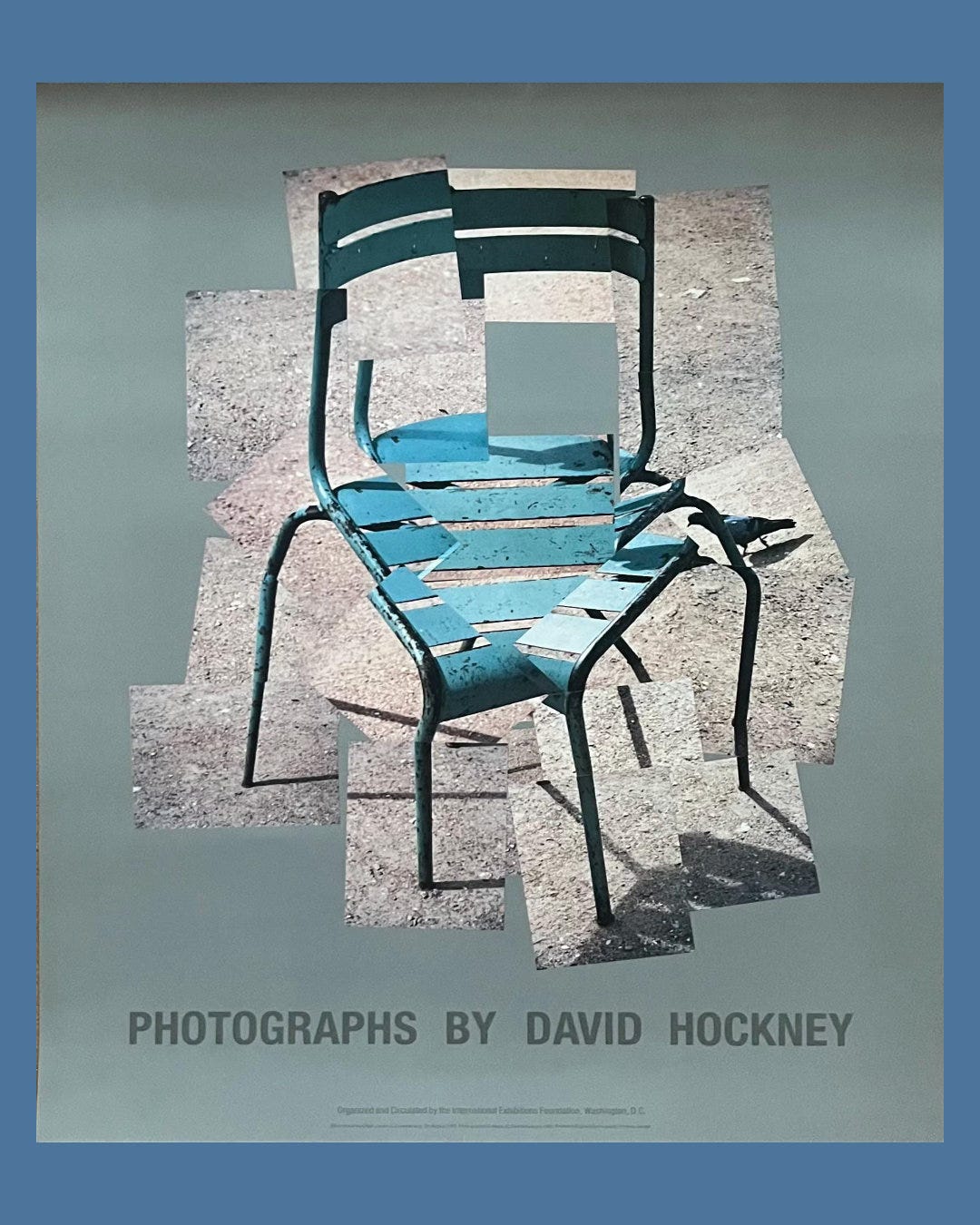
Yesterday, when I heard that David Hockney had passed away, my first thought wasn’t the headlines. My first thought was 1988: being a kid in a museum, reading the small print on an exhibition poster, and realizing the world was far more connected than I understood.
In March of that year, my family and I went to see the Photographs by David Hockney exhibit at the Snite Museum of Art at the University of Notre Dame in South Bend, Indiana. I remember walking up to a poster by myself, scanning the text, and freezing when I saw the words Jardin du Luxembourg and the year 1985.
“Hey, Dad,” I said, “this is from when we were in Paris!”
He came over, looked, and sure enough — it was true. We had been at the Jardin du Luxembourg around that same time.
That moment left a mark on me. I hadn’t traveled much outside South Bend, and as an 11-year-old trying to make sense of life, this felt huge: a place from my own memory showing up inside a fine art exhibit three years later. Something clicked. We’re all closer than we think.
My dad bought me that poster, and it hung in my room for years:
Chair, Jardin du Luxembourg, 7th August 1985, Photographic Collage, © David Hockney 1985, Printed in England by Howards Printers, Slough.
I don’t have that poster anymore. But every time I hear David Hockney’s name, I go right back to that feeling and I still find myself wondering whether, somewhere in that Paris park, our paths crossed without either of us knowing it.
Hockney’s influence followed me into different chapters of my life. In March 2006, I moved to Oakland. The Bay Area has a way of pulling you toward new tools and new ways of thinking, and that’s where I found my way back to his work this time through digital art.
As tablets entered creative workflows, people were quick to dismiss them as not “real” art. Hockney didn’t seem interested in those arguments. He just kept making work by tapping away on that magic glass screen, later with a digital pencil — treating the iPad the way he’d always treated everything else: as a surface worth exploring.
That mattered to me more than I can explain. Seeing a world-renowned artist use an iPad as a legitimate tool gave me permission to trust what I already believed: a new tool doesn’t make art less true. What matters is the eye, the curiosity, and the craft. Being an artist means staying curious, experimenting, and evolving — regardless of the substrate.
Looking back from 1988 to now, Hockney shaped how I see both art and the world. First, he gave me a childhood moment that made everything feel intimate and connected. Later, he showed me that artistic legitimacy is earned through experimentation and evolution — not just tradition.
So yes, I feel sadness today. But more than sadness, I feel gratitude.
Gratitude for that day with my dad. Gratitude for a poster that kept me wondering about the world. Gratitude for an artist who kept evolving — and, in doing so, gave others permission to do the same.
Some influences arrive fast and break things. Others stay quietly with you for decades. David Hockney was both.